Telegram DMCA takedown: how to remove content that copies your work
A Telegram DMCA takedown is a copyright notice that asks Telegram to remove a public channel, group, bot or post reproducing your work without permission. You file it by emailing [email protected] with proof you own the work and the exact links to the infringing posts. It covers copyright only — not scams or general complaints.
What is a Telegram DMCA takedown, and when does it apply?
A Telegram DMCA takedown is the copyright route, not the rule-breaking route. It uses the notice-and-takedown system written into U.S. law under Section 512 of the Copyright Act: you, the rights holder, tell the platform exactly which material copies your work, and the platform removes it once it confirms the claim. It applies only when something you hold copyright in — a video, photo, track, course, ebook or piece of software — has been republished on public Telegram content without your permission. Telegram's own FAQ routes copyright complaints to [email protected] and is blunt about the limit: it handles requests about public channels, groups, bots and sticker sets, and "we do not process any requests related to" private chats. It also expects the notice to come from the owner or an authorised agent, not a bystander.
What can you DMCA on Telegram — and what can't you?
You can only DMCA material that copies a work you actually own the copyright in. That covers a wide range of leaked and pirated content the platform is full of:
- Your videos, films or livestream rips reposted in a channel
- Photos, artwork and brand design assets used without a licence
- Paid courses, ebooks, PDFs and research published behind your paywall
- Music, samples and pre-release tracks shared before launch
- Software, source code and licence keys handed out for free
- Subscription or creator content leaked from a members-only feed
What a copyright notice can't touch is anything that doesn't copy your work. A channel you dislike, a competitor's opinion, an account using your name without any of your copyrighted material, or an outright scam are not copyright matters — and a DMCA notice against them is invalid. Those belong to Telegram's Community Guidelines report route instead, which our Telegram reporting solutions cover separately.
Telegram takedown routes: DMCA vs the in-app Report button
Picking the wrong route is why many requests go nowhere, so match the problem to the channel Telegram built for it. Copyright infringement is a legal notice by email; everything else is an in-app report reviewed against the Terms of Service.
| What's wrong | Where it goes | What governs it |
|---|---|---|
| A channel reposting your copyrighted work | Email to [email protected] | Copyright law (DMCA, Section 512) |
| A scam, phishing bot or illegal-goods channel | In-app Report button + [email protected] | Telegram Terms of Service |
| An account impersonating you or a brand | The @NoToScam bot | Community Guidelines on impersonation |
| A channel you simply disagree with | No valid route | Disagreement isn't a violation |
The distinction is real, not bureaucratic: the copyright route asks a sworn legal question Telegram must weigh, while a tally of complaints does not. If your case is about conduct rather than copying, sending more reports won't help — and neither will a mass report bot, because report volume can't force a takedown the rules don't support.
How do you file a DMCA takedown notice to Telegram?
You file by sending one written notice to [email protected], from the owner or an authorised agent, with every required element inside it. The process is short but precise:
- Confirm you own the copyright, or that you're formally authorised to act for whoever does.
- Open each infringing post and copy its direct t.me/ message link — gather one link per item, not just the channel's name.
- Note where your original lives: the URL, store page or upload that proves the work is yours.
- Write the notice with all six legal elements (listed below), in plain English.
- Email it to [email protected], keep a dated copy, and watch for a reply or for the content to drop.
What must a valid DMCA notice include?
Section 512(c)(3) of the Copyright Act sets six required elements, and leaving one out is a common reason a notice is rejected. Build your email around this checklist:
| Required element | What it means in practice |
|---|---|
| Your signature | A physical or typed electronic signature of the rights holder or agent |
| The work infringed | Identify the original you own (title, link, or a representative list) |
| The infringing material | The exact t.me/ links so Telegram can locate each item |
| Your contact details | Name, email, and an address or phone number |
| Good-faith statement | That you believe the use isn't authorised by you, your agent or the law |
| Statement under penalty of perjury | That the notice is accurate and you're the owner or authorised to act |
The wording sits in the statute itself; the full text of 17 U.S.C. § 512 spells out each line. A tidy notice that already meets every point gives the reviewer nothing to send back.
Why must you report the exact message links, not the whole channel?
Because Telegram reviews specific items, not reputations. The single biggest reason a copyright notice stalls is naming a channel — "@somechannel is pirating my course" — instead of linking the individual posts that carry your work. A reviewer can act on a message link; they can't sift an entire archive to find what you mean. To grab a link, open the message in the Telegram app, tap and hold it, choose Copy Link, and you'll get a public t.me/ address that points straight at that post. List one link per infringing item. If forty videos are stolen, that's forty links, each tied in your notice to the original it copies. The few extra minutes this takes are the difference between a notice a moderator can process in one pass and one that gets parked for lack of detail.
What happens after you send a Telegram takedown notice?
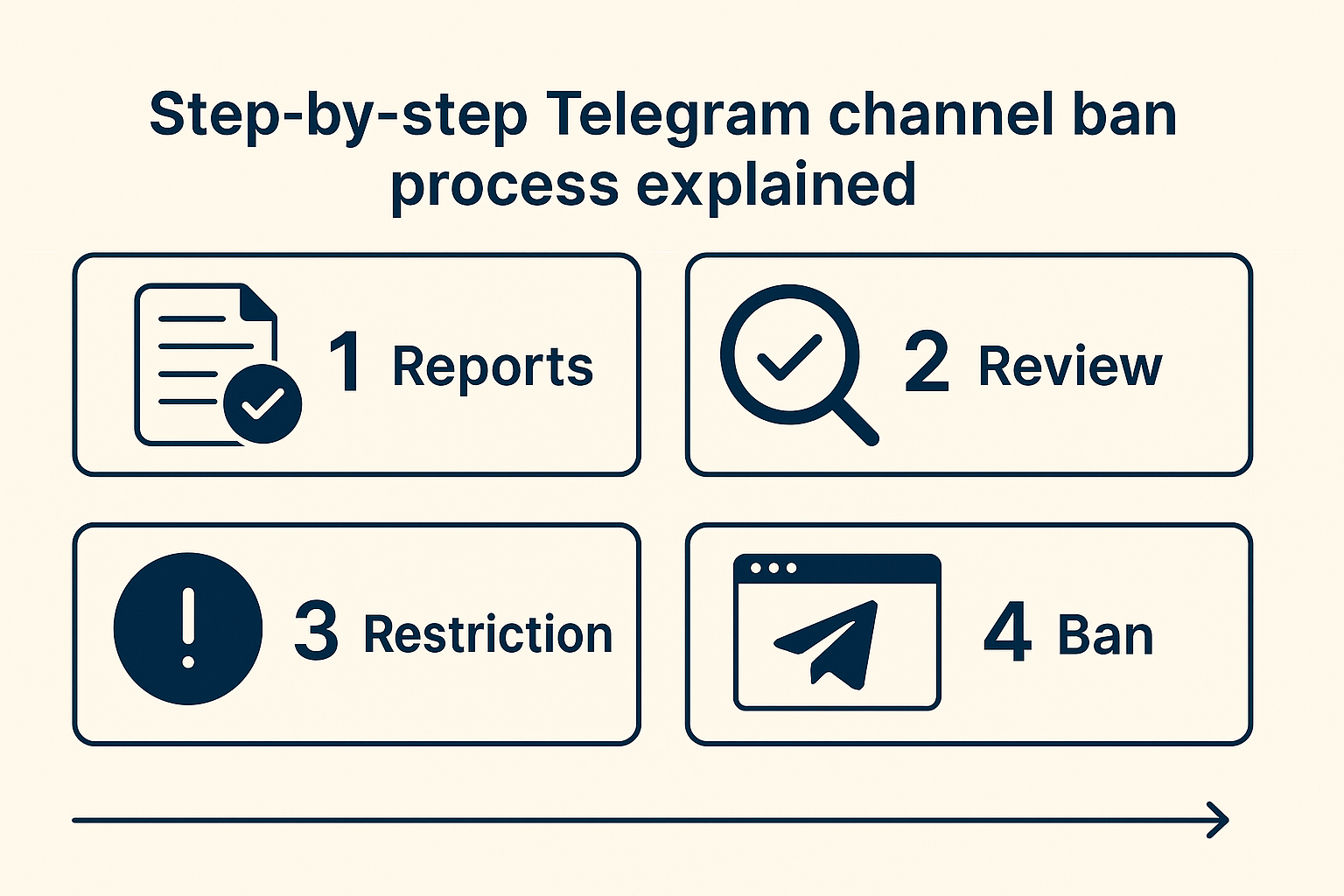
A person reviews it. Telegram's moderation is human-checked, so a volunteer or staff reviewer reads the notice, confirms the links point at your work, and restricts or removes the infringing posts — sometimes the whole channel — if the claim holds up. There's no published service-level deadline, and you usually won't get a verdict email; you'll often just notice the content gone. The uploader can also file a counter-notice claiming the material was removed by mistake or is lawful, after which the law lets the platform restore it unless the rights holder pursues the matter further. Telegram can act against repeat infringers, but a determined operator may reappear under a new username. None of that argues against filing — it argues for filing precisely and keeping records, which is exactly how our reporting desk approaches a genuine case.
Does a DMCA takedown actually work against piracy on Telegram?
For a clear-cut copyright claim, yes — but Telegram is a heavily pirated platform, so removal is often a campaign rather than a single email. The scale is documented: in its October 2025 submission to the U.S. Trade Representative's Notorious Markets list, the RIAA wrote that messaging platforms "Telegram and Discord have become the primary mechanisms through which pre-release music is distributed without authorization," organised inside private and semi-private groups (RIAA, via TorrentFreak, 2025). The practical lesson for any rights holder is that one valid notice clears the links you cite, yet backup channels and re-uploads are common, so expect to monitor and re-file. A DMCA takedown is a strong, lawful tool against the specific posts you name; it isn't a one-click switch that erases a work from the platform forever.
Can a false or careless DMCA notice get you in trouble?
Yes, and this is where copyright takedowns differ sharply from a casual report. A DMCA notice is signed under penalty of perjury, and Section 512(f) makes anyone who knowingly materially misrepresents that material is infringing liable for the resulting damages and legal costs. That means you should never DMCA content you don't own, work that falls under fair use or criticism, or an account you simply want gone — those aren't copyright claims, and filing them anyway is both invalid and risky. Send the notice only as the rights holder or a genuinely authorised agent, claim only what you can prove is yours, and the perjury statement is nothing to fear. If you're unsure whether something is a copyright matter at all, send us the links and we'll tell you honestly before anything is filed.
DMCA, trademark or impersonation — which complaint do you actually need?
It's easy to reach for a DMCA notice when the real issue is a different one, and sending the wrong type is a common reason a complaint stalls. Copyright — the DMCA route to [email protected] — covers a creative work of yours being copied: a video, track, course, photo or piece of software. Your brand name and logo, though, are usually a trademark matter rather than copyright, and a channel merely using your name to pose as you is impersonation, which Telegram handles through its FAQ routes and the @NoToScam bot, not a copyright notice. The quick test: if someone reposted something you made, it's a DMCA takedown; if someone is pretending to be you or misusing your brand without copying your actual content, it's an impersonation or trademark report. Match the complaint to the wrong it addresses and Telegram can act; mislabel it and you've handed the reviewer a reason to set it aside.
Sources
- Telegram FAQ — copyright complaints to [email protected]; public content only, not private chats
- U.S. Copyright Office — Section 512 notice-and-takedown system
- 17 U.S.C. § 512 (Cornell LII) — required notice elements and § 512(f) misrepresentation liability
- TorrentFreak (2025) — RIAA names Telegram a primary hub for pre-release music piracy (USTR Notorious Markets)
FAQ
Is a Telegram DMCA takedown free?
Filing the notice yourself costs nothing. Telegram doesn't charge to receive or act on a copyright complaint sent to [email protected]. You only pay if you hire someone to prepare the notice, chase re-uploads or escalate a case the platform leaves unresolved.
Can I DMCA a private Telegram chat or group?
No. Telegram's FAQ states it only processes takedown requests for public content such as channels, groups, bots and sticker sets, and won't act on private chats between participants. A DMCA notice only reaches infringing material that is publicly available.
How long does a Telegram takedown take?
There's no published timeframe and Telegram promises no deadline. Rights holders report responses ranging from a few days to a few weeks, and a clean, link-by-link notice tends to move faster. No service can guarantee a fixed turnaround or a certain outcome.
Do I need a lawyer to file a DMCA notice to Telegram?
No. The copyright owner or an authorised agent can send the notice directly; a lawyer isn't required. The notice does need every element the law requires and must be truthful, because you sign it under penalty of perjury.
What if the channel re-uploads my content after removal?
File again against the new links. Telegram acts on each notice for the specific items you cite, and determined operators spin up backup channels under fresh usernames, so ongoing monitoring and repeat notices are often part of keeping pirated work down.
Can you file a Telegram DMCA notice if the channel is based in another country?
Yes. The notice goes to Telegram, not to the uploader, so where the channel's operator happens to be doesn't block it — Telegram acts on the infringing content hosted on its own platform. Copyright protection is broad internationally, too, so a foreign-run channel reposting your work is still a valid target. Send the same complete notice to [email protected] with the exact t.me links, and let the platform handle the account behind them.